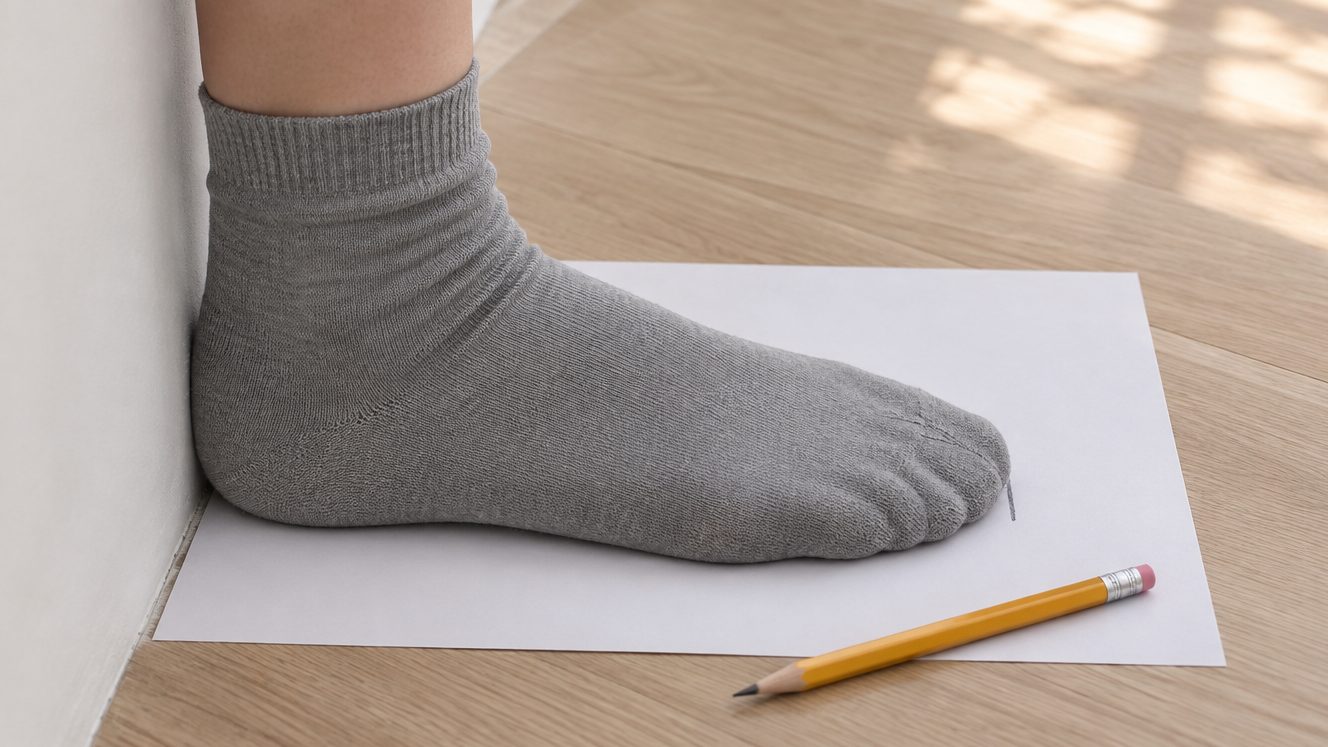
What You Need
Five things, and most homes have all of them:
- A sheet of paper longer than your foot. For large feet, tape two sheets together.
- A pen or pencil.
- A ruler or tape measure marked in millimeters, or in sixteenths of an inch.
- A wall with a hard floor in front of it. Carpet lets the paper shift.
- The socks you plan to wear with the new shoes.
How to Measure Your Foot Length, Step by Step
Measure at the end of the day, when feet are often at their largest. Then:
- Put the paper on the floor with its short edge against the wall. Tape it down so it cannot slide.
- Put on your socks and stand on the paper with your heel gently against the wall. Keep your weight on both feet; do not sit.
- Hold the pen upright and mark the tip of your longest toe. For many people that is the big toe, for some the second toe.
- Step off and measure from the wall edge of the paper to the mark, to the millimeter or the nearest 1/16 inch.
- Repeat with the other foot. Use the longer of the two measurements for both shoes.
If someone can help, let them make the mark while you stand still and look straight ahead. Leaning forward to see your toes shifts your weight. Measure each foot twice; if the readings differ by more than a millimeter or two, measure a third time.
Why a Few Millimeters Matter
US sizes step in half sizes of 1/6 inch, about 4.2 mm. Near the edge of a size, one millimeter decides: on the generic chart a 26.2 cm foot is a men's 9, and a 26.3 cm foot already needs a 9.5.
Two mistakes make a foot look longer than it is. A pen held at an angle marks ahead of the toe, and a heel that drifts off the wall adds the gap to your length. Check both before you write the number down.
Turn Your Measurement Into a Shoe Size
Our generic chart uses the Brannock scale for men: US men's size = 3 × foot length in inches − 22. Women's sizes are men's plus 1.5, so women's = 3 × foot length − 20.5. Nike's men's chart matches it row for row. Some values:
| Foot (cm) | Foot (in) | US men's | US women's |
|---|---|---|---|
| 23.7 | 9.33 | 6 | 7.5 |
| 24.6 | 9.67 | 7 | 8.5 |
| 25.4 | 10 | 8 | 9.5 |
| 26.2 | 10.33 | 9 | 10.5 |
| 26.7 | 10.5 | 9.5 | 11 |
| 27.5 | 10.83 | 10.5 | 12 |
If your length falls between two rows, take the larger size: each row is the longest foot that size fits. The foot length to shoe size converter does this for any length and adds UK and EU sizes. EU sizes follow their own steps, explained in Why EU Shoe Sizes Come in Fractions.
For comparison: ANSUR II, a 2012 survey that measured about 6,000 US Army personnel, found a median foot of 27.1 cm for men and 24.6 cm for women, a US men's 10 and a women's 8.5. More in average shoe size.
Children's feet are measured the same way, and the kids' shoe size chart turns the length into a toddler or youth size.
How Much Room to Leave in Front of Your Toes
Your measurement is the foot, not the shoe. Charts that list foot length expect the bare number, so do not add room to it. Two brands ask for it anyway: ASICS Oceania says to add 1 to 1.5 cm before reading its chart, Birkenstock Australia 10 mm. Do that only with their charts.
Room inside the shoe is a fit check after you have chosen a size. Where brands give a number:
- Nike: about a thumb's width between the big toe and the end of a running shoe.
- ASICS US: half to a full thumb's width at the toes of a running shoe.
- Birkenstock US: about ¼ inch (6 mm) of space around the foot.
So your big toe should not touch the front of an everyday or running shoe. Snowboard boots are the exception: K2 wants your toes to lightly brush the front when you stand straight, because the liners pack out with riding.
Measure Your Foot Width Too
A length chart says nothing about width. With your foot still on the paper, mark both sides of the widest part of your forefoot, across the ball of the foot, and measure between the marks. Use the wider foot.
New Balance publishes the foot width behind each of its width letters. For a men's 9, the standard width D fits a foot 10.4 cm wide and the wide 2E a foot 10.7 cm wide. For a women's 8, standard B is 8.8 cm and wide D 9.2 cm. Note that standard is D for men but B for women.
The shoe width chart covers every size and lists which brands make wide shoes. If your shoes press at the sides while your toes have room, read Do You Need Wide Shoes?
What a Brannock Device Measures That Paper Cannot
The metal device in a shoe store takes a second length: arch length, from the heel to the ball joint of the foot. Shoes are built to bend at the ball, so a foot with a long arch and short toes needs a longer shoe than its heel-to-toe length suggests.
Brannock’s own instructions say to compare both readings and generally use the larger one. If heel-to-toe reads 8 and the arch reads 8½, the size is 8½. If both read the same, that is the size.
At home you only get heel-to-toe. If shoes in your measured size crease or pinch behind the ball of the foot, have both lengths read on a device in a store. How Shoe Sizes Are Calculated explains the scales printed on it.
The CM on a Shoe Box Is Not Your Foot Length
Many shoes show a CM or JP size on the box or the tongue. It looks like a foot length, but often it is not. Of the 40 brands in our database, 25 print foot length in that column. Ten, including Nike, Adidas, Under Armour and On, print a label size instead.
A Nike men's 9 is labeled 27 cm, while the foot it fits measures about 26.2 cm. Compare your measurement with a foot-length column, never with the number on an old box. Why Shoe Sizes Differ Between Brands explains where the gap comes from.
Check the Chart of the Brand You Buy
A generic chart is a starting point. Brands draw their own charts, so the same foot can land on different sizes: by their own charts, a 26.2 cm foot is a Nike US 9 but a New Balance 8.5. Nike vs Adidas vs New Balance Sizing has the full comparison.
Look up your length in the chart of the brand you buy. The brand size comparison puts two brands side by side; it compares the sizes brands print, not the inside length of a particular shoe. If you land between two sizes, read Between Shoe Sizes: Size Up or Down?
Some boots use other systems. Ski boots are sized in Mondopoint, your foot length in centimeters: a 26.5 cm foot is a 26.5 boot. Boot Size vs Shoe Size covers Blundstones, ski boots and hockey skates.
Frequently Asked Questions
Do you measure your feet with socks on or off?
With the socks you plan to wear in the new shoes. A thick hiking or ski sock takes more room than a thin running sock, so measure in the one you will actually use.
How do I convert my foot length to a shoe size?
For US men's sizes, use the Brannock formula: size = 3 × foot length in inches − 22. Women's sizes on the generic chart are men's plus 1.5: size = 3 × foot length − 20.5. A 10-inch (25.4 cm) foot is a men's 8 or a women's 9.5 on the generic chart. Then check the brand's own chart.
How much room should be in the toe of a shoe?
Nike asks for about a thumb's width between the big toe and the end of a running shoe, ASICS for half to a full thumb's width. Birkenstock's US fit guide asks for about ¼ inch of space around the foot.
Should your big toe touch the front of the shoe?
Not in everyday or running shoes: Nike and ASICS want a thumb's width of room. Snowboard boots are the exception. K2 says your toes should lightly brush the front when you stand straight, because the liners pack out.
Should I measure both feet?
Yes. Feet are often not the same length, so measure both and choose the size for the longer foot. For width, go by the wider foot.