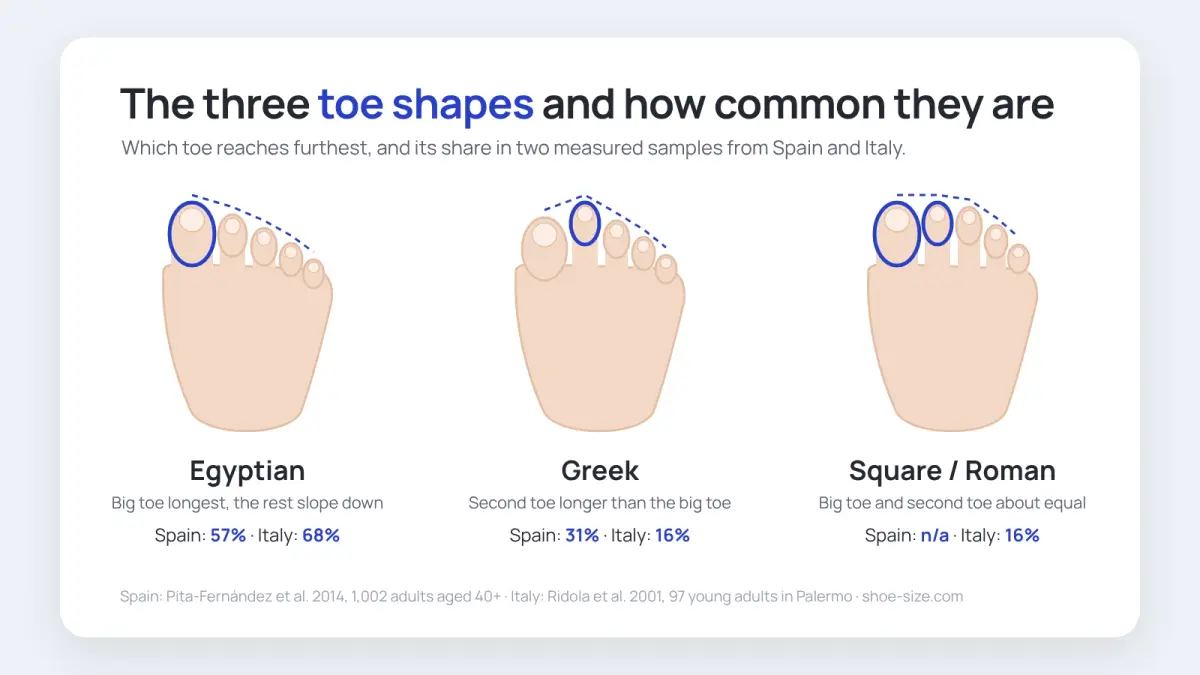
There are three types of feet by toe shape. In an Egyptian foot the big toe is the longest and the other toes slope down. In a Greek foot the second toe is longer than the big toe. In a square or Roman foot the big toe and the second toe are about the same length. The Egyptian foot is the most common: it made up 57.1% in a random sample of 1,002 adults in A Coruña, Spain, and 68% of the feet of 97 young adults in Palermo, Italy. Feet are also typed by arch height (flat, neutral or high) and by width. Labels such as Celtic, Germanic or peasant foot come from internet charts, not from foot research.
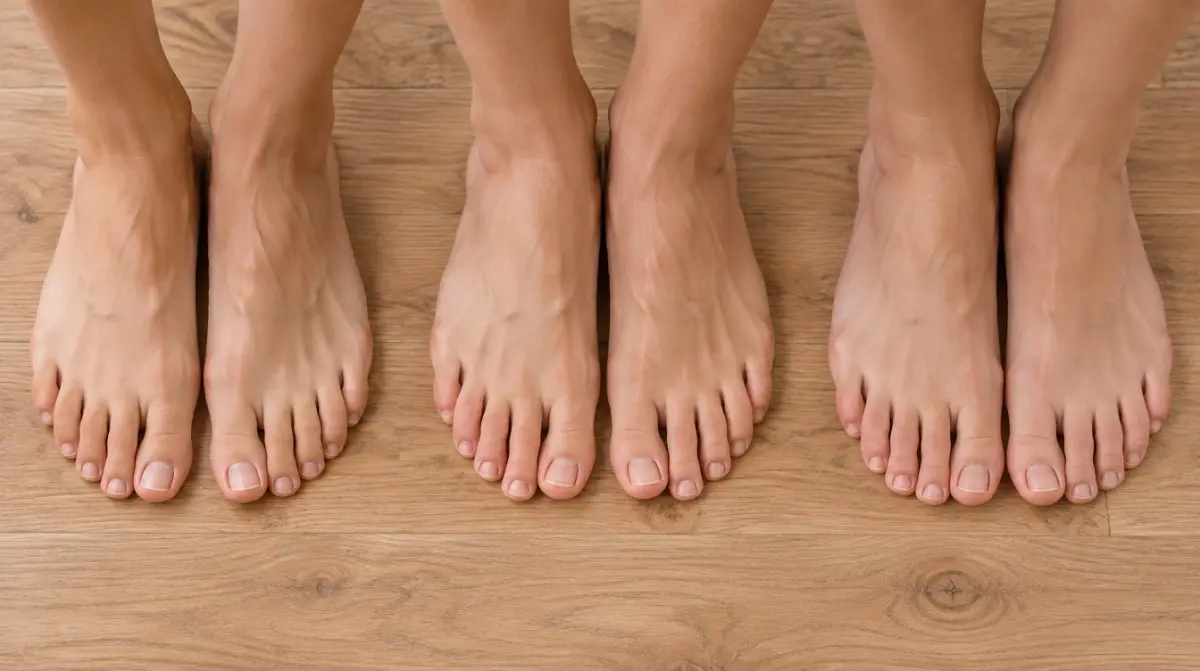
What Are the Different Types of Feet?
Foot types are sorted in three ways, and each one matters for something different:
Toe shape, called the digital formula in medical papers: which toe reaches furthest. This is what Egyptian, Greek and Roman refer to, and it decides which toe touches the front of your shoe first.
Arch height: flat, neutral or high. It changes how the foot spreads when you stand and how much room it needs over the top.
Width: narrow, regular or wide. Your shoe size only measures length, so width is the type your size leaves out.
Most foot type charts online mix all three and add a few invented categories. The sections below take them one at a time, with the measured numbers behind each.
The Three Toe Shapes: Egyptian, Greek and Roman
Egyptian Foot
The big toe is the longest, and each toe after it is a little shorter, so the toe line runs in a diagonal from the big toe down to the little toe. Egyptian toes are the most common toe shape in every sample we found: 57.1% in Spain and 68% in Italy.
Greek Foot (Greek Toe or Morton's Toe)
The second toe reaches further than the big toe. Most sources use Greek foot, Greek toe and Morton's toe for the same thing, including a 2026 meta-analysis by Habib and colleagues, which defines Morton's toe as a second toe longer than the big toe. Some doctors use Morton's toe more narrowly for a short first metatarsal, the long bone behind the big toe, which makes the second toe stick out further.
A Greek foot is not rare. The meta-analysis pooled five studies with 2,636 feet and found a longer second toe in 40% of them, with a range of 28% to 66% between populations. In the Spanish sample the share was 31.4%, in the Italian one 16%.
Square or Roman Foot
The big toe and the second toe are about the same length, so the front of the foot looks straight across. Research papers call this the square type, and Ridola and colleagues found it in 16% of the feet they examined in Palermo. Roman foot is the name most online charts use for a similar shape, usually with the first two or three toes level and the last two dropping off. We found no study that uses the term, so this article treats Roman and square feet as one group.
How Common Is Each Foot Type?
Toe shape | Spain: 1,002 adults aged 40+ (2014) | Italy: 97 young adults (2001) |
|---|---|---|
Egyptian (big toe longest) | 57.1% | 68% |
Greek (second toe longest) | 31.4% | 16% |
Square or Roman (first two toes equal) | not reported separately | 16% |
The Morton's toe meta-analysis widens the picture: across five studies, a longer second toe turned up in 28% to 66% of feet depending on the population, and in 40% on average.
Two caveats. The Spanish study drew a random sample from the population, which makes it the stronger number, while the Italian study examined 97 people at a medical school with an average age of 21. And neither study measured Americans, so the split in the US is not known. What the data agrees on: the Egyptian foot is by far the most common, and the Greek and square shapes trail well behind it.
Celtic, Germanic and Peasant Feet: Where Those Names Come From
Many foot shape charts add more types. The Germanic foot or peasant foot usually means all toes nearly the same length, which gives a wide, square forefoot. The Celtic foot usually means a long second toe with the third, fourth and fifth toes dropping off steeply.
We searched PubMed for these names and found no study that uses them. Anatomically, they are variations of the three shapes above: a Germanic or peasant foot is a square foot, and a Celtic foot is a Greek foot with a steep drop after the second toe. The names also suggest an ancestry that no research supports, which leads to the next question.
Can Your Foot Shape Reveal Your Ancestry or Personality?
No. The share of each toe shape does differ between populations: the meta-analysis found a longer second toe in as few as 28% or as many as 66% of feet, depending on where they were measured. But every shape turns up in every group, so the shape of one foot cannot tell you where your ancestors came from. We also found no study that links toe shape to personality, intelligence or luck. Claims such as "a long second toe means you are a natural leader" are folklore.
Is a Longer Second Toe Dominant or Recessive?
Neither, in the simple sense. Aigbogun and colleagues examined 101 families in Nigeria and found that toe length runs in families, but the pattern did not fit a single dominant or recessive gene. As the authors note, a trait being common does not make it dominant. In their sample, 35.3% had a second toe as long as or longer than the big toe.
Is a Greek Foot Bad for You?
For most people it is simply a normal variation. Researchers have found some links, without proof that the toe shape causes the problem:
The 2026 meta-analysis reports associations between Morton's toe and overpronation (the foot rolling inward), bunions, hammertoes and plantar fasciitis.
In a 1995 study of 59 ballet dancers, women whose second toe was shorter than the big toe had fewer calluses and less daily foot pain than women with an equal or longer second toe, and longer second toes were linked to hallux rigidus, a stiff big toe joint. Among the male dancers, toe length made no difference.
No link was found with ingrown toenails: a Turkish case-control study found the same mix of Egyptian, Greek and square feet in 81 people with ingrown toenails as in 100 people without.
Ballet is the one field that ranks toe shapes. Dancers consider the square type best for pointe work, and in a study of 25 Japanese ballet dancers, those with Egyptian toes swayed more on pointe than those with square toes.
Foot Arch Types: Flat, Neutral and High Arches
Arch height is the second way to type a foot. A flat or low arch lets most of the midfoot touch the ground. A high arch leaves only a narrow strip between the heel and the ball of the foot, or a gap.
A 2026 US study of 1,015 adults used a pressure mat and found at least one flat foot in 11.1% and at least one high arch in 18.3%. Both feet were flat in 3.5% and both had high arches in 8.7%. The study set its cutoffs statistically, at one standard deviation from the average, so the exact shares depend on that choice.
In the Spanish random sample of adults aged 40 and older, 19% had flat feet, more often with age and with a higher body mass index.
A 2023 review of 12 studies with 16,000 children and adults put flat feet at 15.6% overall.
Arches also change over a lifetime. They tend to flatten with age and after a first pregnancy, which is one reason a shoe that fit at 30 can feel tight years later. Our article Do Feet Get Bigger With Age? has the numbers.
Foot Width: The Type Your Shoe Size Leaves Out
Two feet of the same length can differ a lot in width. In the US Army's ANSUR II survey, men aged 17 to 24 had an average foot width of 10.18 cm and women of the same age 9.25 cm. If your shoes press on the sides while your toes still have room, width is the type to fix, not length: going half a size up adds only 1 to 2 mm of width, as our guide Do You Need Wide Shoes? shows. The shoe width chart lists the width letters for each size.
How to Find Your Foot Type at Home
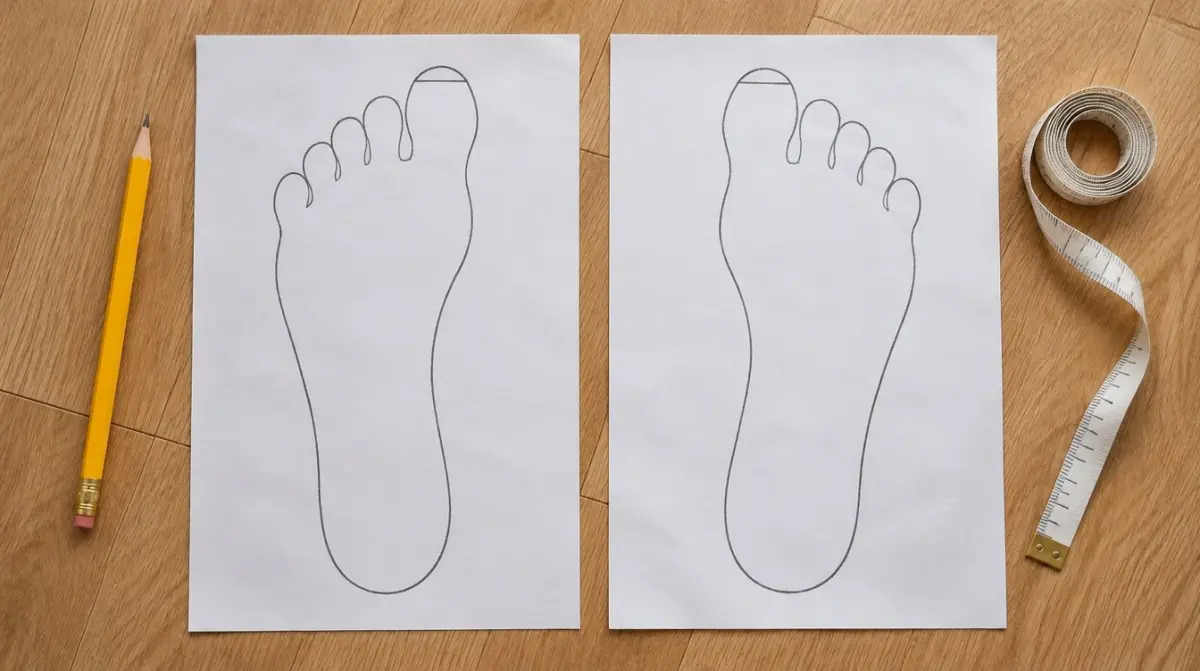
You need two sheets of paper, a pencil and a tape measure.
Trace both feet. Stand on the paper with your weight on both feet, hold the pencil upright and trace around each foot.
Mark the longest toe. Draw a short line across the tip of the toe that reaches furthest. If it is the big toe, you have an Egyptian foot. If it is the second toe, a Greek foot. If both are level, a square or Roman foot.
Compare both feet. They do not always match: in the Italian study, 18% of people had a different toe shape on the left and the right foot.
Check your arch. Wet the sole of your foot and step onto a paper bag or a dark tile. A wide band between heel and ball points to a flat arch, a thin band or a gap to a high arch. Researchers measure footprints in a similar way, and in the Spanish study footprint measurements matched a clinician's flatfoot diagnosis well.
Measure length and width. Measure from the heel to the longest toe and across the widest part of the forefoot. Our guide to measuring your feet walks through it, and the foot length chart turns your length into a size.
What Your Foot Type Means for Your Shoe Size
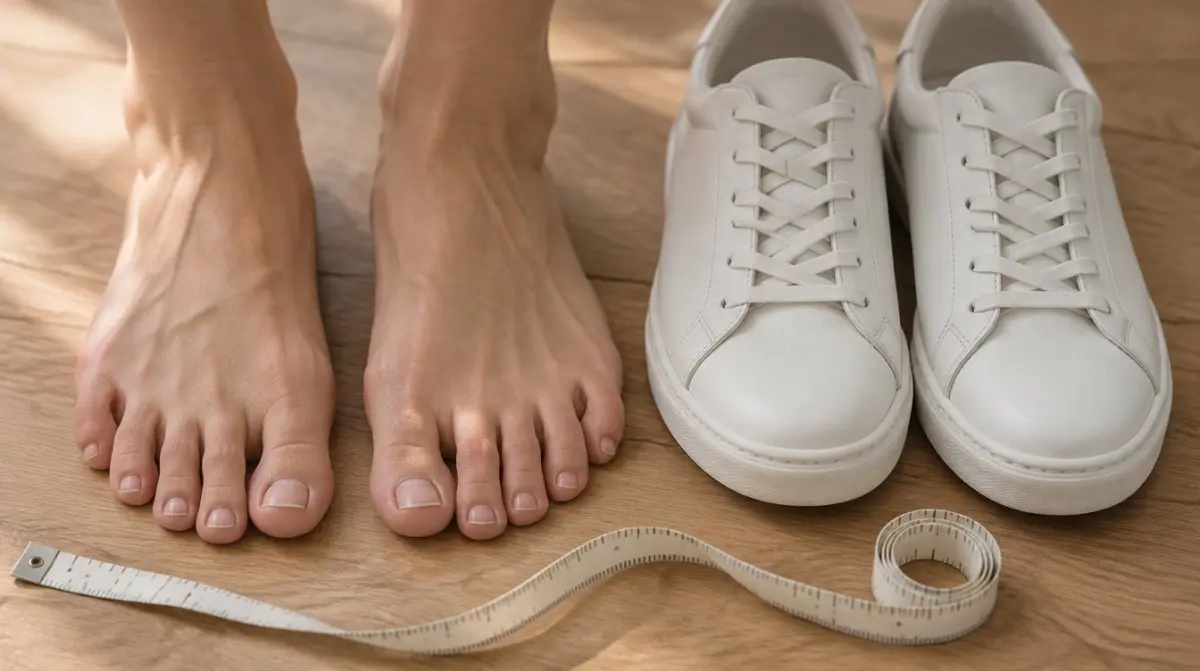
Your toe shape does not change the size number on the box, but it decides which toe sets it.
Size by your longest toe. With a Greek foot, your second toe sets your foot length, not your big toe. Our measuring guide marks the tip of the longest toe for that reason; measuring only to the big toe gives a length that is too short.
Match the toe box to your toe line. Lay the shoe's insole on your tracing. Your toe line should fit inside the outline of the insole, at the big toe for an Egyptian foot, at the second toe for a Greek foot and at the outer corners for a square foot.
Fix width with width, not length. If the sides of your forefoot press, a wider fit in your usual length helps more than a bigger size.
Common Questions
What are the five types of feet?
There is no official list of five. Online charts usually name the Egyptian, Greek, Roman, square and Celtic (or Germanic or peasant) foot. Research uses three toe shapes, Egyptian, Greek and square, and the other names are variations of them.
What is the most common foot type?
The Egyptian foot, with the big toe longest. It was the most common shape in a random sample of 1,002 adults in Spain (57.1%) and among 97 young adults in Italy (68% of feet).
What is the rarest foot type?
Probably the square or Roman foot. In the Italian sample it tied with the Greek foot at 16% of feet. The Spanish study did not report it separately, but it can account for at most 11.5% there, since Egyptian (57.1%) and Greek (31.4%) feet make up the rest. The Greek foot is far from rare: a longer second toe showed up in 40% of feet on average across five studies.
Is it normal for your second toe to be longer than your big toe?
Yes. A second toe that is longer than the big toe is called a Greek foot or Morton's toe, and depending on the population it occurs in 28% to 66% of feet. Studies have linked it to bunions, hammertoes and calluses, but they have not shown that it causes them.
What is the most desirable foot shape?
For everyday shoes, none is better than another. The only field that ranks toe shapes is ballet, where the square type is considered best for pointe work.
Can your foot type change?
Your toe shape mostly stays the same, because it depends on the length of the bones. Arch height and width can change: arches tend to flatten with age, weight gain and pregnancy, which can make your feet longer and wider when you stand.
Sources
Pita-Fernández S, et al. Podiatric medical abnormalities in a random population sample 40 years or older in Spain. Journal of the American Podiatric Medical Association, 2014.
Ridola C, et al. Symmetry of healthy adult feet: role of orthostatic footprint at computerized baropodometry and of digital formula. Italian Journal of Anatomy and Embryology, 2001.
Habib ZMH, et al. Prevalence of Morton's toe: a systematic review and meta-analysis. F1000Research, 2026.
Aigbogun EO, et al. Morton's toe: prevalence and inheritance pattern among Nigerians. International Journal of Applied and Basic Medical Research, 2019.
Ogilvie-Harris DJ, et al. The foot in ballet dancers: the importance of second toe length. Foot & Ankle International, 1995.
Kizawa M, et al. Effect of toe type on static balance in ballet dancers. Medical Problems of Performing Artists, 2020.
Kose O, et al. Is there a relationship between forefoot alignment and ingrown toenail? Foot & Ankle Specialist, 2011.
Jackson JB, et al. Classifying foot arch morphologies using high-sensitivity pressure mat technology. Cureus, 2026.
Pita-Fernández S, et al. Validity of footprint analysis to determine flatfoot. Journal of Epidemiology, 2015.
Salinas-Torres VM, et al. Prevalence and clinical factors associated with pes planus among children and adults. Journal of Foot and Ankle Surgery, 2023.
ANSUR II, 2012 Anthropometric Survey of US Army Personnel (Gordon et al. 2015).