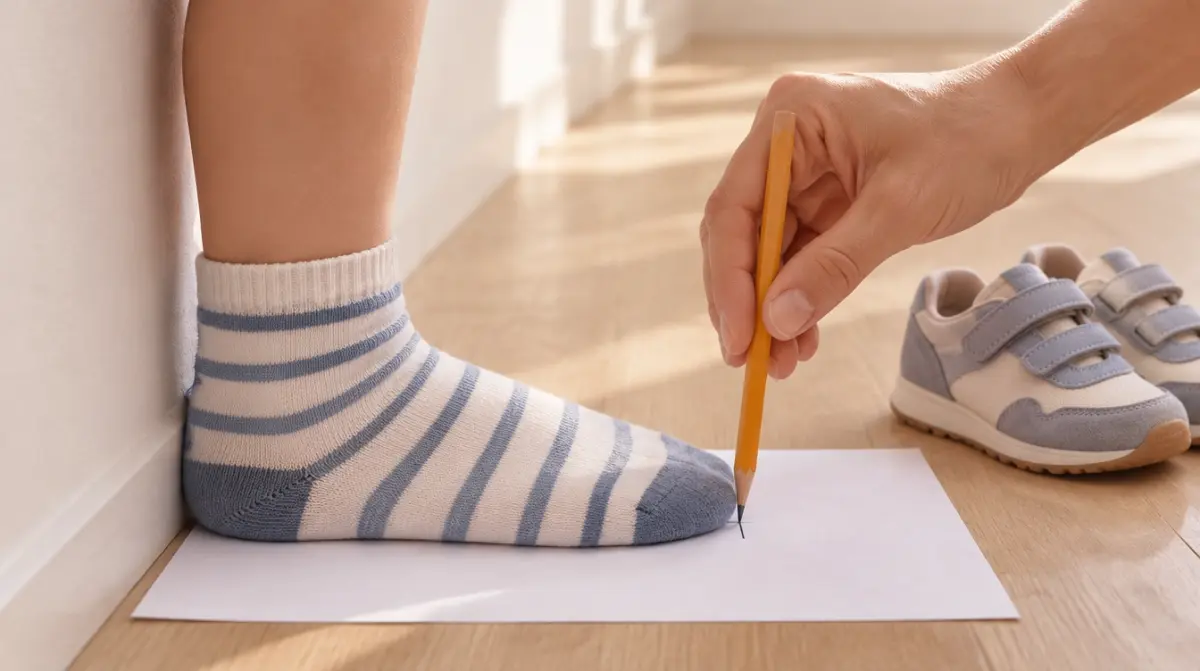
Children's feet grow faster than most parents expect, and young children rarely say when a shoe has become tight. Stride Rite says baby and toddler feet can grow half a size or more every few months, and it recommends measuring every two months. Measuring at home takes five minutes and a sheet of paper. Here is how to do it, how much room to leave in the shoe, and when to measure again.
What You Need
A sheet of paper, larger than your child's foot
A pencil
A ruler or tape measure in centimeters
A hard floor next to a wall
The socks your child will wear with the new shoes
How to Measure Your Child's Foot
Stand, don't sit. Put the paper on the floor against the wall. Your child stands on it with the heel touching the wall and weight on both feet. A foot that carries weight is longer than one that dangles.
Wait for relaxed toes. Children often curl their toes when they stand still on paper. Wait until the toes lie flat.
Mark the longest toe. Hold the pencil upright and make a small mark at the tip of the longest toe, which is not always the big toe.
Measure. Measure from the wall to the mark in centimeters, to the nearest millimeter.
Repeat with the other foot and use the longer of the two.
With toddlers who will not stand still, a second adult helps: one keeps the heel at the wall, the other makes the mark. Our general guide shows how to measure your feet in more detail.
How Much Room to Leave in Kids' Shoes
Your number is the length of the foot, not of the shoe. The shoe needs extra room in front of the toes:
The podiatry department of NHS Lothian in Scotland advises "a thumb's width of extra space between the tip of the longest toe and the end of the shoe."
Stride Rite's fit guide says to press the tip of your thumb against the toe of the shoe. Your child's toes should have room to wiggle without pressing against the front, "but not so much room that their feet can slide forward."
That second point matters. Buying two sizes up so a child can grow into the shoe creates exactly the sliding Stride Rite warns about. NHS Lothian also says shoes should be comfortable from the start and should not need to be broken in.
To turn the measured length into a size, use our kids' shoe size chart or the foot length chart. Then check the room at the toe when your child tries the shoe on.
How Fast Children's Feet Grow
Babies and toddlers grow fastest. In a study of 6,284 children in Xi'an, China, the median foot length of boys rose from 11.29 cm at 9 months to 15.07 cm at 36 months: almost 4 cm in just over two years.
School-age children grow about 1 cm a year. A German study of 7,788 children found an average foot length of 13.1 cm at age 1 and 24.4 cm at age 13, just under 1 cm per year.
Girls' feet stop growing earlier. In a Beijing study of 3,490 children, the median girl's foot measured 23.0 cm at 12, 13 and 14, while the median boy's foot still grew from 24.5 cm at 12 to 25.5 cm at 14.
Median foot length in the Beijing study:
Age | Boys | Girls |
|---|---|---|
3 | 14.8 cm | 14.5 cm |
6 | 18.0 cm | 18.0 cm |
9 | 21.0 cm | 21.0 cm |
12 | 24.5 cm | 23.0 cm |
14 | 25.5 cm | 23.0 cm |
Our kids' shoe size chart by age shows these numbers next to the shoe size each foot needs.
When to Measure Again
Babies and toddlers: every two months, as Stride Rite recommends.
Older children: NHS Lothian advises checking shoes regularly and replacing them quickly once they are too small or worn out. Measuring before every new pair is a simple rule to follow.
Whenever the fit looks wrong: toes pressing against the front when you press with your thumb, or a child who keeps taking the shoes off.
Common Questions
How do I measure my toddler's feet at home?
Have your toddler stand on a sheet of paper with the heel against a wall, mark the tip of the longest toe, and measure from the wall to the mark in centimeters. Measure both feet and use the longer one. A second adult makes it much easier.
How much room should kids' shoes have at the toe?
About a thumb's width between the longest toe and the end of the shoe, according to NHS Lothian's podiatry department. The toes should wiggle freely, but the foot should not slide forward.
How often should I measure my child's feet?
Every two months for babies and toddlers, as Stride Rite recommends, and before every new pair for older children.
Should I buy kids' shoes a size bigger?
Not by more than the room described above. A shoe that is too long lets the foot slide forward, and NHS Lothian says shoes should be comfortable from the start.
Sources
NHS Lothian Podiatry, Children's Footwear patient leaflet (2022); Stride Rite kids' shoe fit guide and sizing help; Feng et al. 2026, Annals of Human Biology (Xi'an, ages 9–36 months); Müller et al. 2012, Gait & Posture (Germany, ages 1–13); Wu et al. 2024, Frontiers in Public Health (Beijing, ages 3–18).
Frequently Asked Questions
Warum sollte ich die alte Schuhgröße nicht als Maßstab nehmen?
Die Zahl auf der Sohle zeigt nur die Größe, die der Hersteller einmal vergeben hat, nicht die aktuelle Fußlänge deines Kindes. Schuhe verändern sich beim Tragen, Marken fallen unterschiedlich aus und Kinderfüße wachsen in Schüben. Deshalb solltest du neu messen und die Fußlänge mit der Innenlänge des neuen Schuhs vergleichen.
Was brauche ich zum Messen des Kinderfußes?
Du brauchst ein Blatt Papier, das größer als der Fuß ist (bei großen Füßen zwei Blätter oder Pappe), einen dünnen Stift, ein Lineal oder starres Maßband sowie eine Wand oder Schrankseite als Anschlag für die Ferse. Eine druckbare Schablone oder Fußmesslehre ist optional. Ein biegsames Maßband, das am Fuß entlanggelegt wird, ist nicht nötig.
Wie messe ich den Fuß richtig?
Lass dein Kind mit der Ferse an der Wand stehen, sodass sie anliegt, und den Fuß gerade nach vorn zeigen. Das volle Gewicht sollte auf dem Fuß liegen. Markiere die längste Zehe mit dem Stift senkrecht nach unten und lies mit dem Lineal den Abstand zwischen Wandkante und Markierung ab. Nicht runden. Barfuß oder in dünnen Socken messen. Wenn du eine Schablone ausdruckst, stelle die Skalierung auf 100 Prozent und schalte die Seitenanpassung aus.
Warum messe ich beide Füße und welchen Wert nehme ich?
Oft gibt es ein paar Millimeter Unterschied zwischen links und rechts. Für den Schuhkauf zählt der längere Fuß, denn der muss schmerzfrei hineinpassen. Notiere beide Werte mit Datum, damit du beim nächsten Nachmessen sehen kannst, wie viel gewachsen ist.
Wie berechne ich die passende Schuhgröße aus meiner Messung?
Addiere zur Fußlänge des längeren Fußes in Millimetern rund 12 Millimeter Zugabe. Das ergibt die Innenlänge, die der Schuh haben sollte. Diese Innenlänge vergleichst du mit der Angabe im Schuh bzw. der Herstellertabelle. Die 12 mm sind ein Richtwert, kein fester Wert für jedes Alter, und Hersteller rechnen unterschiedlich.